






Journal of Studies on Alcohol and Drugs
A recent meta-analysis reveals that mixing energy drinks with alcohol significantly increases the risk of injuries from car accidents and fights. The perceived boost in intoxication is linked to psychological beliefs rather than the drinks' actual ingredients, leading to higher risks of risky behaviors among those who consume these combinations.
In This Article
- What are the risks of mixing energy drinks with alcohol?
- How do energy drinks influence perceptions of intoxication?
- What methods reveal the psychological effects of drink labeling?
- How can understanding these effects influence safe drinking practices?
- What are the limitations and potential misconceptions of this research?
People who add energy drinks to alcohol have a higher risk of injury from car accidents and fights, compared to those who drink alcohol straight. This is the conclusion of a meta-analysis of 13 studies published in March in the Journal of Studies on Alcohol and Drugs. 
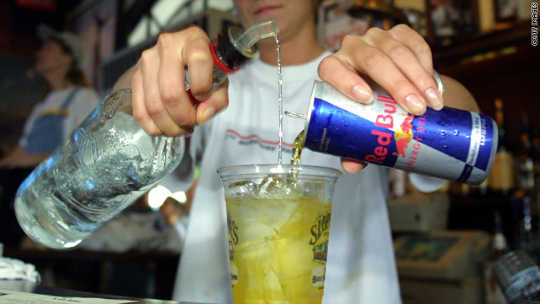
Energy drinks, such as Red Bull, Monster, or Rockstar, contain ingredients that are considered stimulants, such as caffeine or guarana. The reality of their effects has however been a matter of dispute for several years already.
An experiment conducted by our team from INSEAD Business School, the University of British Columbia, and the University of Michigan, shed new lights on the effects of mixing alcohol and energy drinks. In an article forthcoming in the Journal of Consumer Psychology, already available online, we show that the associations that people have with the popular vodka and Red Bull cocktail can increase perceived intoxication and lead to risky behaviors.
However, these effects are not driven by the ingredients contained in energy drinks. They are linked to the beliefs that people have that energy drinks boost the intoxicating effects of alcohol. It is a psychological effect, not a physiological one.
73 percent of US college students mix alcohol and energy drinks
Cocktails mixing alcohol and energy drinks are popular in many countries. A 2011 study in a French university found that they were consumed by 54 percent of French students (64 percent for males and 46 percent for females). This proportion reached 73 percent among American students and 85 percent in Italy, according to a study published in the British Medical Journal.
Compared to people who drink alcohol straight, those who mix it with energy drinks have double the risk of experiencing or committing sexual assault, or of being involved in a drunk driving accident, according to a JAMA article.
Some researchers have hypothesised the existence of a causal relation between the ingredients present in energy drinks and risky behaviors. They argue that energy drinks, because of the caffeine that they contain, mask the intoxication effects of alcohol, fooling people who are drunk into believing that they are not.
The masking hypothesis, however, has been refuted in a recent meta-analysis of nine studies. This study showed that that the amount of caffeine typically found in energy drinks is too low to change perceived intoxication.
The role of beliefs
All these studies have in common that they were “blind,” meaning that the participants did not know whether they were consuming alcohol mixed with an energy drink or alcohol alone. Because of that, these studies missed an important part of the story: the psychological impact that energy drinks can have because of people’s beliefs.
For our experiment, we recruited 154 young heterosexual Parisian men of comparable body mass who were social drinkers but had no risk of alcohol dependence. Under the pretense of studying “bar behaviors,” we invited them to the INSEAD Sorbonne University Behavioral Lab, in Paris. We asked them to drink a cocktail containing 6 centilitres (2 ounces) of 40 percent Smirnoff vodka (a common amount in one drink), 8 centilitres (2.7 ounces) of Red Bull Silver Edition energy drink, and 16 centilitres (5.4 ounces) of Caraïbos Nectar Planteur (a blend of fruit juices).
We randomly assigned the participants to one of three groups, where the only difference was the name the drink was called by – “vodka Red Bull cocktail” which emphasised both the energy drink and the alcohol, “vodka cocktail” which emphasised only the alcohol, and “exotic fruits cocktail” which emphasised neither alcohol nor the energy drink.
Measuring sexual confidence and risky behaviour
After waiting for 30 minutes for the cocktail to have an effect, we showed the (male, heterosexual) participants, photos of 15 young women, one by one. After looking at each photo, the participants reported their intention to approach and “chat up” the woman represented in each photo, and their prediction of whether the woman would share her phone number. Measures such as these were used to create sexual self-confidence scores.
To measure general risk-taking, participants could earn money by blowing up a virtual balloon. Each pump inflated the balloon and added money to a counter. Participants could cash-out before the balloon exploded (which happened randomly) or keep pumping at the risk that it would explode, resulting in the loss of the money accumulated on the trial.
Finally, we also asked the participants how long they would wait (in minutes) to sober up before driving, and how drunk they felt.
Same cocktail, different sensations of drunkenness…
Given that the young males in all three groups had the same drink, there was no difference in actual intoxication levels across the three drink-name groups. However, people in these three groups felt drunk to different extents – those in the “vodka Red Bull” label group felt 51 percent more drunk than those in the other two groups. This effect was even stronger for participants who most strongly believe that energy drinks increase alcohol intoxication. This is characteristic of a placebo effect, like the those found among patients taking an innocuous drug. So, the more people believe that energy drinks boost the effects of alcohol, the more the “vodka Red Bull” label increased perceived intoxication.
Next, we found that the young men in the “vodka Red Bull” label group took more risks in the balloon game and were more sexually self-confident. These placebo effects were also reinforced by how much people believed that drunkenness increases impulsiveness and removes sexual inhibitions. The silver lining in the study was that that the “vodka Red Bull” label also made participants intend to wait longer before driving.
Our results suggest a causal relationship between mixing energy drinks and alcohol and two risky behaviours, seduction behaviours and gambling. They confirm the association found in the meta-analysis mentioned earlier but contribute by providing evidence for one mechanism for the effect, albeit a psychological, not a physiological, one.
… and varying caution before driving
One of the unexpected results of our study is that emphasizing the presence of an energy drink in an alcohol cocktail makes people more careful before considering driving. This may seem to be contradicted by the association between car crashes and the consumption of alcohol mixed with energy drinks. It suggests that this association may be explained, not by a cause-and-effect relation, but by the possible fondness of those who drive recklessly for mixing alcohol and energy drinks. It is a hypothesis that merits further research.
The key issue is the promotion of disinhibiting and risky behaviors by energy-drink brands through sponsorship and advertising. We now know that exposing consumers to these messages turns an innocuous ingredient into an active placebo. Even if these effects are only fantasised, their consequences are nonetheless real.
About The Authors
Pierre Chandon, Professeur de Marketing et Directeur du Centre Multidisciplinaire des Sciences Comportementales, INSEAD – Sorbonne Universités; Aradhna Krishna, Dwight F Benton Professor of Marketing, University of Michigan, and Yann Cornil, Assistant professor, marketing and behavioral science division, Sauder school of business, University of British Columbia
This article was originally published on The Conversation. Read the original article.
Further Reading
-
Influence: The Psychology of Persuasion, Revised Edition
The article demonstrates that a drink's label alone — not its ingredients — can shift how intoxicated people feel and how recklessly they behave, which is a textbook example of the psychological mechanisms Robert Cialdini spent decades mapping. His landmark work explains how expectations, social cues, and framing shape human decisions in ways that bypass conscious reasoning entirely. For anyone trying to understand why energy drink branding is so potent even when the pharmacology is not, this is the foundational text.
Amazon: https://www.amazon.com/exec/obidos/ASIN/006124189X/innerselfcom
-
The Emperor's New Drugs: Exploding the Antidepressant Myth
Harvard Medical School's Irving Kirsch, the researcher who originated the concept of response expectancy, builds a rigorous case that what people believe a substance will do to them often matters more than what the substance actually does — a principle that sits at the heart of the vodka Red Bull study described in this article. His dissection of placebo mechanisms in clinical drug trials offers a clear scientific framework for understanding how belief-driven intoxication works and why it produces measurably real consequences. The book is accessible without sacrificing the depth of the underlying research.
Amazon: https://www.amazon.com/exec/obidos/ASIN/0465022006/innerselfcom
-
Drunk: How We Sipped, Danced, and Stumbled Our Way to Civilization
University of British Columbia philosopher Edward Slingerland draws on archaeology, cognitive neuroscience, and social psychology to explain why humans drink alcohol and what it actually does to behavior — including how it lowers inhibition, increases risk tolerance, and reshapes social dynamics in ways that go well beyond simple pharmacology. His analysis of alcohol's psychological and cultural effects provides essential context for the kind of placebo-driven behavior changes the Paris study uncovered. It is the most scientifically grounded and entertaining overview of intoxication currently available.
Amazon: https://www.amazon.com/exec/obidos/ASIN/0316453358/innerselfcom
Article Recap
Mixing energy drinks with alcohol can lead to increased perceived intoxication and risky behaviors, primarily driven by psychological beliefs. Caution is advised when consuming these combinations, as the consequences can be significant.
#InnerSelfcom #AlcoholRisks #EnergyDrinks #DrunkDriving #RiskyBehavior #PlaceboEffect