InnerSelf.com
  • Home
  • Articles
    • Personal Empowerment
      • Attitude Adjustments
        • Anger Management
        • Behavior Modification
        • Fear and Worry
        • Forgiveness & Acceptance
        • Gratitude & Service
        • Perfectionism
      • Happiness and Success
        • Counseling
        • Creating Realities
        • Life Changes
        • Life Purpose
        • Performance
        • Self-Help
      • Intuition & Awareness
        • Astrology
          • Horoscope
          • Chinese & Eastern
          • Planets & Transits
            • Retrograde Planets
          • Sun, Moon, Rising Signs
        • Dream Interpretation
        • Intuitive Awareness
      • Relationships
        • Communication
        • Couples
          • Sexuality
        • Family
        • Friendship
        • Parenting
        • Yourself
      • Spirituality & Mindfulness
        • Death & Dying
        • Inspiration
        • Meditation
        • Mindfulness
        • Religions & Beliefs
    • Living In Harmony
      • Finance & Careers
        • Career & Success
        • Prosperity & Finance
      • Health & Wellness
        • Diseases & Conditions
        • Environmental
        • Fitness & Exercise
        • Food & Nutrition
          • Healing Diet
          • Herbs & Supplements
        • Healing Disciplines
      • Home & Garden
        • Feng Shui
        • Gardening
        • Pets & More
      • Leisure & Creativity
      • Science & Technology
    • Social Consciousness
      • At The Brink
        • Authoritarianism
        • Injustice
        • Pestilence
        • Wars
        • Climate Disruption
      • Culture Differences
      • Democracy
        • Activism
        • Elections
        • Historical
        • Reforms
      • Economy
        • Education
        • Healthcare
        • Inequality
      • Environment
        • Climate
          • Adaptation & Mitigation
          • Evidence Of Warming
          • Impacts
          • Solutions
        • Political
        • Weather
      • Hostilities
      • Justice
        • Civil Liberty
        • Economic
        • Privacy & Security
      • Trends
  • Videos
  • Bookshelf
  • Search
  • More
    • Today's Uptake
    • Today's Inspiration
    • List All
    • Newsletter
    • Privacy Policy
    • RSS
    • Admin
    • Contact Us
    • Test Page
InnerSelf.com
  • Home
  • Articles
    • Personal Empowerment
      • Attitude Adjustments
        • Anger Management
        • Behavior Modification
        • Fear and Worry
        • Forgiveness & Acceptance
        • Gratitude & Service
        • Perfectionism
      • Happiness and Success
        • Counseling
        • Creating Realities
        • Life Changes
        • Life Purpose
        • Performance
        • Self-Help
      • Intuition & Awareness
        • Astrology
          • Horoscope
          • Chinese & Eastern
          • Planets & Transits
            • Retrograde Planets
          • Sun, Moon, Rising Signs
        • Dream Interpretation
        • Intuitive Awareness
      • Relationships
        • Communication
        • Couples
          • Sexuality
        • Family
        • Friendship
        • Parenting
        • Yourself
      • Spirituality & Mindfulness
        • Death & Dying
        • Inspiration
        • Meditation
        • Mindfulness
        • Religions & Beliefs
    • Living In Harmony
      • Finance & Careers
        • Career & Success
        • Prosperity & Finance
      • Health & Wellness
        • Diseases & Conditions
        • Environmental
        • Fitness & Exercise
        • Food & Nutrition
          • Healing Diet
          • Herbs & Supplements
        • Healing Disciplines
      • Home & Garden
        • Feng Shui
        • Gardening
        • Pets & More
      • Leisure & Creativity
      • Science & Technology
    • Social Consciousness
      • At The Brink
        • Authoritarianism
        • Injustice
        • Pestilence
        • Wars
        • Climate Disruption
      • Culture Differences
      • Democracy
        • Activism
        • Elections
        • Historical
        • Reforms
      • Economy
        • Education
        • Healthcare
        • Inequality
      • Environment
        • Climate
          • Adaptation & Mitigation
          • Evidence Of Warming
          • Impacts
          • Solutions
        • Political
        • Weather
      • Hostilities
      • Justice
        • Civil Liberty
        • Economic
        • Privacy & Security
      • Trends
  • Videos
  • Bookshelf
  • Search
  • More
    • Today's Uptake
    • Today's Inspiration
    • List All
    • Newsletter
    • Privacy Policy
    • RSS
    • Admin
    • Contact Us
    • Test Page

How Do Children Learn Empathy?

By Justin H G Williams, Senior Clinical Lecturer in Child Psychiatry, University of Aberdeen
Justin H G Williams, Senior Clinical Lecturer in Child Psychiatry, University of Aberdeen

How Do Children Learn Empathy?

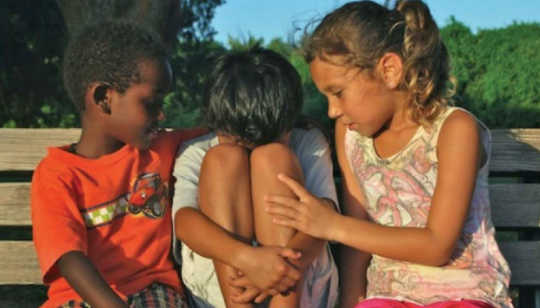
Empathy, the ability to understand others and feel compassion for them, is arguably the most defining human quality – setting us apart from smart machines and even other animals. Without it, we couldn’t function in social areas such as the schools, court rooms and office workplaces that are the cornerstones of our society.

But babies and toddlers are generally poor at showing sensitivity to other people’s feelings. So how do they develop this crucial skill – do they learn it gradually or is it just an innate ability that kicks in at a certain age?

Empathy involves being sensitive to the emotions of others, understanding those emotions and responding in an appropriate way. Studies on how empathy develops need to look at how children understand and respond to emotions rather than their ability to recognise them. This is because children who have difficulties with empathy generally have little or no difficulty in identifying emotional reactions in others, but rather in understanding the purpose or cause of it.

For most children empathy seems to come naturally. Others may be perfectly capable of understanding the emotions of others but choose to respond in an inappropriate way, such as being aggressive. On the other hand, children with autism spectrum disorder may be very sensitive to the emotions of others but at the same time have difficulty in understanding those emotions and knowing how to respond. That difficulty can result in negative social experiences, leading to poor social confidence and social withdrawal.

This shows just how important the development of empathy is: poor social skills in childhood have been linked to a number of issues in adulthood – ranging from relationship and mental health problems to low income and substance abuse.


innerself subscribe graphic


An imitation game

It has long been known that early experiences of social interactions shape the way we respond to others. Classic experiments in the 1960s showed that children were more aggressive after seeing aggression – and also copied specific aggressive behaviours. This may not seem to have anything to do with empathy, but it actually shows how important imitation is for children to learn patterns of emotional responses.

Newborn infants may not be very interactive but they are capable of a form of simple facial mimicry. Try sticking out your tongue in front of a newborn baby and he or she may copy you. Within a few months, babies progress to reciprocal smiles. At three months of age infants are reflecting the emotions of their parents. For instance, babies of mothers with high levels of anxiety have been shown to smile less than others as a result of their mothers smiling less. It may not seem like it, but this is the very first stage of empathy.

Between six and 12 months, an infant can differentiate between different types of emotional expressions and begins to understand that other people have intentions. The imitation behaviour continues and becomes more frequent over the first two years of life. In the second year, children also develop the ability to pretend and imitate behaviours in order to simulate emotions in others, rather than just immediately copying reactions. Emotional expressions in others evoke a child’s own memories of similar emotional experiences – the foundation of empathy.

By the age of four, children can separate truth from falsehood and intentional behaviour from accidental acts. While these are great tools for learning empathy, it doesn’t mean that a child is ever fully developed in this regard. Empathy is something we keep on developing for the rest of our lives.

But are some children born with a brain that is wired to be more empathetic? Neuroscience models have traditionally tried to separate empathy into various components – such as cognitive, emotional and expressive – located in separate brain regions. However, we are increasingly realising that the pathways used to perceive and express emotion are fundamental parts of the learning process of attributing intentions to emotional experiences – be it via gestures, actions, facial expressions or words. Empathy is therefore tied to sensory and motor systems which means that, like any other aspect of development, it cannot be treated as an isolated ability.

So it really seems that empathy can be cultivated – relying on adults and peers modelling appropriate emotional responses to events at changing levels of complexity as a child grows. It also depends on the capacity to think about, imagine and reflect on emotional experiences, which may explain why reading fiction appears to improve empathy.

But there will always be individual differences in capabilities to learn from past experiences and coordinate responses. It’s also important to keep in mind that children who experience a negative or emotionally indifferent environment at home are likely to develop different expectations of emotions in others, perhaps such as finding more positive or more complex emotions hard to understand. For example, a child born to hostile or neglectful parents will learn to be biased to attribute negative intentions to others.

Thankfully, the days when it was acceptable to be cruel to children to “toughen them up" are over. But as a society we still have some way to go in recognising what we can do to promote healthy emotional development – such as empathy – both in our families and in the wider social context.

About The Author

williams justinJustin H G Williams, Senior Clinical Lecturer in Child Psychiatry, University of Aberdeen. He is a child and adolescent psychiatrist interested in the processes involved in the development of social learning imitation and empathy, particularly with respect to autism spectrum disorder.

This article originally appeared on The Conversation

Related Book:

{amazonWS:searchindex=Books;keywords=learning empathy;maxresults=1}

break

Thanks for visiting InnerSelf.com, where there are 20,000+ life-altering articles promoting "New Attitudes and New Possibilities." All articles are translated into 30+ languages. Subscribe to InnerSelf Magazine, published weekly, and Marie T Russell's Daily Inspiration. InnerSelf Magazine has been published since 1985.

follow InnerSelf on

facebook icontwitter iconyoutube iconinstagram iconpintrest iconrss icon

innerself subscribe graphic


Available Languages

MOST READ

dfgety589ghj

The $20K Drone That Broke Modern Warfare

Robert Jennings, InnerSelf.com
A veteran who read NATO's real nuclear war plans at the Fulda Gap sees a familiar pattern in the Iran war — and it's worse than what's…
Deal or no deal? Duncan Andison

Emotions in Economic Decision-Making

Nicholas Hanley, University of St Andrews
The intersection of psychology and economics reveals that while traditional models depict humans as rational decision-makers,…
Should Kids Be Given Antibiotics In Their First Year?

Understanding Antibiotic Use in Infants

Penelope Bryant, Murdoch Childrens Research Institute
The rise in antibiotic use among infants raises concerns about antibiotic resistance and its implications for child health. With two-thirds…
Should Troubled Nuclear Reactors Be Subsidized?

The Unfulfilled Promises of U.S. Nuclear Power

Peter Bradford, Vermont Law School
Since the 1950s, U.S. nuclear power has been buoyed by taxpayer subsidies and promises of economic and environmental benefits. However,…
The Animal Messengers' Unconditional Love Lessons

Creating Inner Sanctuary Through Animal Connections

Rev. Linda Martella-Whitsett
The teachings of Animal Messengers reveal the profound meaning of sanctuary as a space of safety, connection, and respect for all beings.…
djgjtyu eir4g weior245

Rome Fell This Way: American Decline and China Dominance

Robert Jennings, InnerSelf.com
America spent $50 trillion on wars it lost while China built the future. The pattern is older than either nation. Rome fell this way too.…
Subscribe1
Breaking Free from Toxic Bonds: A Mother and Son Story

Breaking Free from Toxic Bonds: A Mother and Son Story

When a mother becomes emotionally enmeshed with her adult son, it can sabotage marriages and personal growth. In this real-life story, Barry Vissell explores emotional incest, boundary-setting,...

Five Easy Ways to Increase the Joy in Your Life

Five Easy Ways to Increase the Joy in Your Life

Are you ready to increase joy in your life? This article offers five easy ways to boost happiness, from engaging in joyful activities to making simple lifestyle changes. These tips will help you...

How To Help Teen Girls’ Mental Health Struggles

How To Help Teen Girls’ Mental Health Struggles

  It’s a well-established fact that children’s and teens’ mental health took a hit during the pandemic. But new research suggests that teen girls in particular are suffering in unprecedented...

Depression, Anger, and Sadness as Related to Yang Body Types

Depression, Anger, and Sadness as Related to Yang Body Types

We all have a unique path in life that, if traveled, brings out the best in us. Yet no path is ever forged for us, and we may have to bushwhack our way through unchartered wilderness when our...

Loss of A Loved One, A Job, or Even A Belief: Strategies for Moving through the Grieving Process

Loss of A Loved One, A Job, or Even A Belief: Strategies for Moving through the Grieving Process

Grief is a natural reaction to loss and is something each of us will go through at some point in our lives, whether it is due to the loss of a loved one, a job, or even a belief. When something we...

Holding On To Hope Is Easier With Wisdom From Poets Through The Ages

Holding On To Hope Is Easier With Wisdom From Poets Through The Ages

As we begin to glimpse what might be the beginning of the end of the pandemic, what does hope mean? It’s hard not to sense the presence of hope, but how do we think of it?

  1. You are here:  
  2. Home
  3. Articles
  4. Personal Empowerment
  5. Relationships
  6. Parenting
  7. How Do Children Learn Empathy?
INNSELF-TRACK