






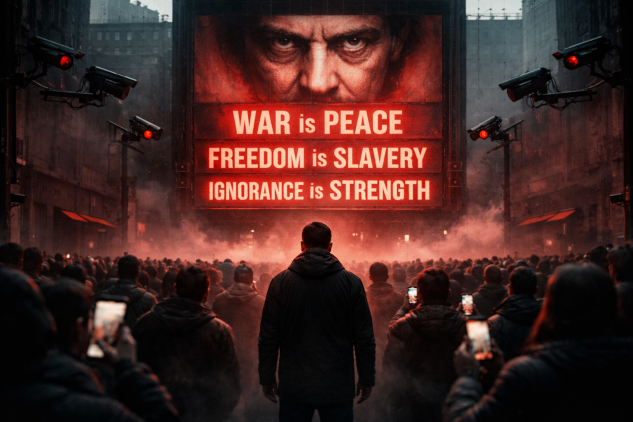
George Orwell is no longer cited as a warning. He's cited as a description. That shift happened quietly, without announcement, and it tells you everything about where we are. Orwell spent his life documenting how power corrupts language, truth, and thought. We spent decades treating his work as dystopian fiction. Now we live in institutions that operate exactly as he described, and we call it Tuesday.
In This Article
- Why Orwell is cited as description, not warning anymore
- How political control operates through language before force
- The difference between persuasion and conditioning—and why it matters
- Why clarity became dangerous and confusion became useful
- How surveillance works through self-censorship, not cameras
- What modern institutions do that Orwell documented decades ago
- Why all sides claim him—and why that neutralizes his message
- The question his work forces on anyone paying attention
The real issue isn’t whether Orwell was right. It’s why we keep acting like he was overstating things. When you read "1984" or "Politics and the English Language" today, the unsettling part isn’t that these warnings could come true—it’s realizing they already have. We’ve gotten used to what he described. We treat as normal what he called out as dangerous. This shift happened so slowly that mentioning it now makes you seem overdramatic.
That’s how it happens. You don’t suddenly wake up in a totalitarian state. Instead, you slowly end up in a society where truth is up for debate, language is used as a weapon, and being clear is seen as extreme. Eventually, you notice that Orwell described all of this years ago, and we’re just repeating it.
The Dissonance We've Normalized
The word "Orwellian" has become a shortcut. People use it when something feels off, but often don’t explain why. That’s an issue. George Orwell wasn’t just speaking in metaphors. He described real methods of political control he saw in empires, wars, and propaganda.
We’ve gone from noticing manipulation to seeing it as normal. Politicians lie, and we barely react. The media repeats talking points word for word, and we call it journalism. Corporations use language that hides responsibility, and we accept it as standard business talk. This isn’t new, but it’s happening more often. That matters because making these things normal is more dangerous than open repression.
Repression leads to resistance. Normalization leads to people going along with it. When corruption becomes just part of the background, people stop pushing back, adjust, and take part without thinking. That was Orwell’s warning—not a sudden takeover, but a slow decline that goes unnoticed.
Here’s the contradiction: we quote Orwell all the time but ignore his real message. We treat his warnings as just literary tools, not real instructions. We’ve made his criticism so harmless that quoting him feels safe. That should worry us more than anything he wrote.
Who George Orwell Actually Was
Orwell wasn’t just a novelist who wrote about politics. He was a journalist who used stories to show what he had seen—as a policeman in Burma, living in poverty, at war, and under propaganda. His books were based on real patterns he noticed, not just imagination.
He didn’t trust any ideology. He was a democratic socialist who criticized socialism, hated imperialism but didn’t idealize the colonized, and disliked both fascism and communism. He cared more about truth than taking sides, which made him hard to use for anyone with an agenda. People like the idea of him as a genius, but the reality is that he reported on power and saw patterns everywhere.
Power Shapes Reality Through Language
Orwell’s main point was straightforward: language is the main tool for political control. If you control how people think, you control how they act. To shape thought, you shape language. Change the words people use, and you change what they can say. Limit what they can say, and you limit what they can think. It’s simple, but it works.
Words are changed, softened, or turned around. For example, "enhanced interrogation" means torture, "collateral damage" means civilian deaths, and "rightsizing" means layoffs. These terms aren’t accurate—they just make bad things sound technical. That’s intentional.
Orwell saw that when language is corrupted, thinking becomes corrupted too. If you can’t name something, you can’t think about it or fight it clearly. Language isn’t neutral; it’s where power wins before any real fight begins.
Modern institutions have refined this to a science. Every press release, corporate statement, or political speech aims to obscure liability while sounding reasonable. They don’t want to convince you; they want resistance to be linguistically awkward. If words to describe the problem elude you, you’ll assume nothing’s wrong. That’s the game. Orwell explained the rules, yet we keep playing anyway.
The PoliClarity is a threat to those in power. If people really understand what’s going on, they might push back. Modern institutions avoid being clear, using professional jargon to keep things vague. They want everything to sound so complicated that most people just trust the experts.
Persuasion uses facts and arguments to change minds, but conditioning uses repetition and emotions to bypass thinking. Orwell saw this change happen. Propaganda stopped trying to persuade and started trying to condition people. Today’s media does the same thing—not by arguing, but by repeating messages and using emotional triggers. and algorithmic repetition.
Orwell recognized this pattern in wartime propaganda and we've industrialized it across every institution. Political campaigns, corporate messaging, media coverage—all of it optimized for confusion rather than clarity. The people running these systems aren't stupid. They're strategic. Confused populations are compliant populations. Clarity threatens that. Thus, clarity gets marginalized, mocked, or ignored. Simple as that.
Truth vs Narrative: The Line That Disappeared
Orwell pointed out the difference between truth and party loyalty. Truth is what actually happened. Party loyalty is the version your group tells about what happened. Today, people care more about keeping the story straight than about facts. If the story fits, serves the right goals, and leads to the right conclusions, accuracy often doesn’t matter.
Admitting error is now seen as a weakness. Politicians who change positions based on new evidence get accused of flip-flopping. Institutions that acknowledge mistakes get sued. Individuals who admit they were wrong lose social status. So everybody doubles down. The incentive structure punishes honesty and rewards obstinacy.
Orwell called this "doublethink"—holding contradictory beliefs simultaneously while denying the contradiction. Now, we all live in carefully shaped realities. Social media shows you things you already agree with. News outlets target specific groups. Even search results are tailored to you. Everyone gets their own version of reality, and there’s no common ground. This isn’t by chance—it’s how the system works. Conflict keeps people interested, and agreement doesn’t get clicks.
The psychological toll is real. People feel anxiety defending views they don’t believe, sense cognitive dissonance but can't name it, and know something’s wrong but can’t say what. Orwell described this exhaustion decades ago—we're tired for the same reasons but pretend otherwise.
Surveillance Is Not the Point—Compliance Is
People focus on surveillance in "1984," but that’s not the main point. Surveillance is just a tool. The real goal is to make people think they’re being watched so they censor themselves. True political control comes from self-censorship.
When people start watching what they say, avoid tough questions, and steer clear of controversial topics without being told, that’s when power wins. No one needs to use force or direct censorship. Just make it risky to speak openly, and people will silence themselves. Orwell saw and understood this. The Thought Police didn’t win by catching everyone—they won because everyone thought they might get caught.
Modern surveillance uses better technology but the same approach. Your browsing, shopping, and location data are all tracked and analyzed. The real question is: what do you change because you think someone might be watching? The real issue isn’t surveillance itself, but the compliance it causes.
People start to police themselves. They report others for saying the wrong thing and make sure everyone follows the rules, even without being told. These rules become so ingrained that outside enforcement isn’t needed. Orwell called this the last stage of totalitarianism—a society that locks itself up. We’re not there yet, but we’re getting closer.
Modern Parallels Orwell Would Recognize Instantly
Today’s political and corporate language is as misleading as anything Orwell described. People aren’t fired—they ‘pursue new opportunities.’ There are no layoffs, just ‘restructuring.’ Failures are called ‘implementation challenges.’ Our way with words would impress the inventors of Newspeak.
The media today often repeats the same points but calls it a debate. Different channels, same messages. Different hosts, same perspective. It looks like there’s variety, but there’s little real disagreement. Orwell saw this with wartime propaganda. Now, it’s everywhere. The goal isn’t to inform, but to make certain stories feel true by repeating them often.
Creating fake enemies to justify more control is nothing new, but Orwell described it well. Every authoritarian system needs a big threat to allow emergency rules that never go away. The enemy changes as needed, but the process is always the same. Fear gives power, and power needs fear. This cycle keeps going until someone stops it.
Why does outrage culture help those in power more than real dissent? Because outrage is scattered energy. It creates noise but not solutions. People get mad about real problems, but their anger turns into public displays instead of real action.
Dissent takes thought, planning, and hard work. Outrage just takes a tweet. Which do you think institutions prefer? Orwell would spot this right away. Anger that leads nowhere is safer than thinking that leads to change.
Why Everyone Claims Orwell—and Why That Misses the Point
Every group quotes Orwell to support their own side. Conservatives use him to criticize the left. Progressives use him to talk about fascism and big business. Libertarians use him to warn about government overreach. Everyone finds something in his work because he criticized all sides. But he wasn’t taking sides—he was showing how power corrupts, no matter the ideology.
Orwell doesn’t belong to any group. As soon as you claim him for your side, you weaken his criticism. You turn his warning into a brand. That’s the risk of quoting him selectively—it makes his message serve political goals he never supported. He didn’t write to give political groups ammunition. He wrote tools for anyone willing to look honestly at power.
How does making criticism safe take away its power? By turning bold ideas into approved talking points. By letting people quote Orwell but ignore his real message. When "Orwellian" becomes just a buzzword instead of a clear warning about language and reality, it loses its meaning. That’s exactly what Orwell warned about: language being twisted to help those in power.
The sad part is that people use Orwell’s broad message for their own side. Instead of seeing that power corrupts everyone, people use his work to say only the other side is bad. That misses the point. Orwell’s real value is that he didn’t let anyone off the hook. If you think his criticism doesn’t apply to you, you’ve missed the lesson.
What Orwell Would Be Targeting Today
Orwell would focus on institutions, not people. He wouldn’t bother with specific politicians or business leaders. He’d look at the systems that reward dishonesty, punish honesty, and mix up loyalty with morality. These systems go beyond any one person. They last no matter who’s in charge because they’re built into the structure.
He would criticize media organizations that value access to power more than holding it accountable. He would show how money influences what gets reported. He’d point out how individuals move between journalism, government, and corporate PR. It’s not that every journalist is corrupt, but the system makes corruption normal. When telling the truth can end your career and lying gets you ahead, most people adjust. Orwell would explain why this happens.
Corporate language would be one of his main targets. He’d call out the vague words and jargon meant to hide the truth, and the whole system built to avoid responsibility while keeping things unclear. Orwell knew that language showing who has power and who benefits is risky for those in charge. Language that hides these facts is useful to them. He would document today’s corporate talk just like he did with political language in his time.
Why would people on all sides distrust him? Because he wouldn’t pick a side. He would criticize both the left and the right equally. He would point out hypocrisy no matter who was guilty. He would demand honesty even when everyone else wanted to stick with their group. That makes you unpopular with anyone focused on winning for their side. Orwell knew this, but he did it anyway. We could learn from that.
Why His Voice Still Matters
Orwell was like an early warning system that we decided to ignore. He pointed out patterns, but we treated them as just stories. He showed how power works, but we thought it couldn’t happen to us. He explained that corruption grows slowly, by becoming normal, not through big events. We made everything he warned about seem normal and called it progress. Now we live in the world he described, but act like we don’t.
When you treat a warning as an exaggeration, you don’t act to prevent the problem. You wait until it’s obvious, only to find you can’t fix it because the words and ideas you need have already been twisted. Orwell warned about this. He said that if you can’t name what’s happening, you can’t fight it. We’ve lost a lot of ground here. Most people can’t even explain what feels wrong anymore.
People who tell the truth are often called pessimists. Being optimistic is more popular because hope is easier to sell than honesty. But Orwell wasn’t a pessimist—he was a realist. He knew that societies can get worse, power can grow, and people can get used to things they once rejected. Calling him pessimistic is just a way to avoid facing his real message.
The difference between giving up and being realistic is action. Despair says nothing can be done. Realism looks at the facts and finds possible solutions.
Orwell was a realist. He didn’t promise we’d win. He just said that understanding how power works is the first step to fighting it. We skipped that step, and now we’re dealing with the results. His voice matters because he still gives us the tools we need. The real question is whether we’ll use them.
The Question Orwell Forces on the Reader
Are we willing to stand up for the truth even if it costs us friends or comfort? That’s the main question in Orwell’s work. It’s not about whether we know the truth—most people do. It’s about whether we’ll stick to it when it makes us unpopular, risks our jobs, or leaves us alone. That’s how control works—not by changing private beliefs, but by making it too costly to be honest in public.
Are we more loyal to the facts or to fitting in? Orwell knew that most people care more about belonging than about being right. We’re social creatures. Being left out hurts, and fitting in feels important. Systems use this by making people accept obvious lies to stay in the group. Most people choose to belong. Orwell explained why. He didn’t blame anyone—he just pointed it out.
What happens when it’s risky to state the obvious? You end up with societies where everyone knows what’s going on, but no one can talk about it. People see the corruption, but saying so has consequences. This isn’t just a dystopian idea—it’s happening in many places right now. Orwell described how it works, and we’re proving he was right.
However, the real question isn’t if Orwell was right. It’s whether we’re willing to admit it—and do something about it.
Admitting it means we have to change. We have to look at what we’ve accepted as normal, which lies we’ve believed, and where we’ve given up on being clear. That’s hard work, and most people avoid it. Orwell didn’t write to make us comfortable. He wrote to help us act.
The tools are there. We can use them or not, but there are consequences either way.
George Orwell wrote, "If liberty means anything at all, it means the right to tell people what they do not want to hear." We have liberty written into our Constitution, in the Bill of Rights, and embedded in our laws. But actually speaking up is where we fall short—not because it’s against the law, but because it comes at a cost. We’re quietly moving from legal limits to social pressure. Orwell knew that social enforcement works better than legal bans. He was right about that, too.
About the Author
 Robert Jennings is the co-publisher of InnerSelf.com, a platform dedicated to empowering individuals and fostering a more connected, equitable world. A veteran of the U.S. Marine Corps and the U.S. Army, Robert draws on diverse life experience, from real estate and construction to building InnerSelf.com with his wife, Marie T. Russell, bringing a practical, grounded perspective to life's challenges. InnerSelf grew from InnerSelf Magazine, founded by Marie T. Russell in 1985, which became InnerSelf.com in 1996. Decades later, InnerSelf continues to inspire clarity and empowerment.
This article is licensed under a Creative Commons Attribution-NonCommercial-NoDerivatives 4.0 License. You may share it with attribution to Robert Jennings, InnerSelf.com, and a link back to the original article at InnerSelf.com. Commercial use and derivative works are not permitted without permission.
Further Reading
-
1984
Orwell’s novel remains the clearest fictional model of how power maintains itself by breaking the link between words and reality. It sharpens the article’s focus on doublethink, narrative enforcement, and the quiet slide from external censorship to internal self-policing. Read it less as prediction and more as a diagnostic map of how compliance is manufactured.
Amazon: https://www.amazon.com/exec/obidos/ASIN/0451524934/innerselfcom
-
Propaganda
Bernays lays out the logic of mass persuasion as a deliberate, engineered process, which directly supports the article’s argument that conditioning often replaces genuine persuasion. It helps explain how institutions shape perception through managed language, repetition, and emotional triggers. This is useful context for understanding why confusion can be politically functional.
Amazon: https://www.amazon.com/exec/obidos/ASIN/0970312598/innerselfcom
-
Amusing Ourselves to Death: Public Discourse in the Age of Show Business
Postman explains how public language degrades when information systems reward entertainment over clarity. It connects tightly to the article’s theme that modern media can make truth linguistically awkward and politically expensive, pushing people toward performative outrage instead of coherent dissent. The book strengthens the argument that the medium and its incentives can quietly reshape what a society can think and say.
Amazon: https://www.amazon.com/exec/obidos/ASIN/014303653X/innerselfcom
Article Recap
George Orwell understood political control as systematic corruption of language, truth, and thought. He documented how power operates through confusion rather than conviction, how surveillance breeds self-censorship, and how institutions benefit when clarity becomes socially dangerous. His work wasn't prediction—it was pattern recognition from someone who'd watched empires, wars, and propaganda machines operate up close. We've moved from treating Orwell as cautionary tale to living inside the systems he described, proving him right by pretending he was exaggerating. The question isn't whether Orwell understood power. It's whether we're willing to admit he did—and maintain the clarity, linguistic precision, and commitment to truth that resistance requires. Political control succeeds when people police themselves. Orwell showed us how. We're showing him he was right.
#GeorgeOrwell #PoliticalControl #Orwellian #LanguageManipulation #PowerAndLanguage #PoliticalLanguage #SurveillanceState #TruthAndPower #Propaganda #MediaManipulation