







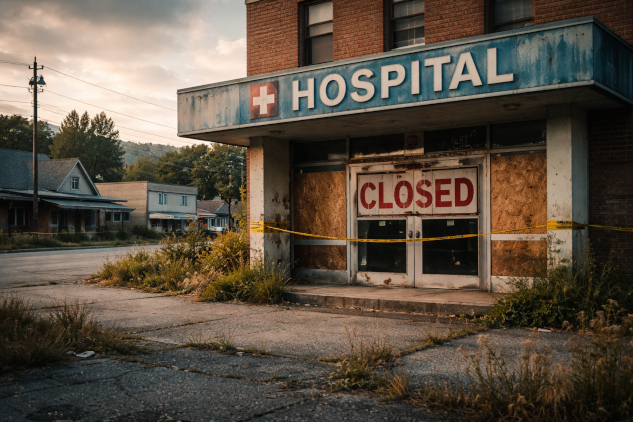
Rural hospitals are vanishing across Trump country. The same voters who delivered him the White House are now driving 40 miles for an ER, losing maternity wards, and watching their towns collapse when the hospital closes. America spends more per capita on healthcare than any nation on earth. The rural communities that trusted the most are getting the least. This is what healthcare betrayal looks like from the inside.
In This Article
- Which rural hospitals have already closed — and how many are next?
- How did Trump's signature legislation put 700 rural hospitals at risk?
- Who specifically is losing care — and where do they live politically?
- How much are Americans paying compared to countries with far better rural access?
- What does the rest of the developed world do differently — and for less money?
- Are there communities quietly finding their own way through?
He stood at rallies in rural Ohio, Pennsylvania, and Georgia and told the people what they needed to hear. He saw them. The forgotten ones. The ones the coastal elites had left behind. The ones whose factories closed and whose towns hollowed out and whose kids moved away for work. He was going to fight for them. He was going to put them first. He said it so many times, with such conviction, that millions of people who had been burned before decided to believe it one more time.
That is the oldest con in American political history. Find the people who have been hurt. Tell them you feel it. Tell them you will fix it. Win the election. Then govern for the people who actually paid for the campaign.
Rural voters delivered for Donald Trump. Overwhelmingly. Repeatedly. They were not naive people. They were people who had run out of other options and decided this time might be different. You can respect that choice and still reckon honestly with what happened next.
What happened next was the One Big Beautiful Bill. Signed into law on July 4, 2025. The largest cuts to Medicaid in the program's sixty-year history. Roughly one trillion dollars has been removed from the healthcare coverage that rural Americans depend on more than anyone else in this country. A bill that researchers at the University of North Carolina estimate puts more than 300 rural hospitals at immediate risk of closure. A bill that, by some projections, could ultimately shutter up to 700 rural hospitals, leaving one-third of every rural hospital standing in the United States.
He signed it on Independence Day. You really cannot make this up.
Meet the People Paying the Price
Consider a woman we'll call Carol, 67 years old, living outside a small town in rural Tennessee. She has been on dialysis for two years. Three times a week, without fail, she needs treatment, or she dies. The hospital that provided that treatment locally closed last spring. Now her daughter drives her 38 miles each way, three times a week, to the nearest facility still operating. That is nearly 12,000 miles a year in a pickup truck with 190,000 miles on it, to keep her mother alive. Carol voted for Trump in 2016, 2020, and 2024. She believed him when he said he would protect Medicare and Medicaid. She does not yet fully understand that the bill he just signed is why her hospital closed.
Consider a man we'll call Dale, a 54-year-old crop farmer in rural Kansas. He is self-employed, as most farmers are, which means he buys his own health insurance. Or rather, he did, until the premiums hit $2,200 a month for a policy with a $9,000 deductible. He has been uninsured for three years now. He manages a chronic heart condition with whatever he can afford out of pocket, skipping the specialist appointments because the specialist is 60 miles away, and the copay alone would break him. Dale went to four Trump rallies. He still has the signs in his barn. He does not connect his situation to the political choices he has made because nobody in his media ecosystem has ever laid it out plainly.
Consider a young woman we'll call Maria, 28 years old, seven months pregnant, living in one of the 22 Pennsylvania counties that no longer have a hospital offering labor and delivery services. Her nearest option for giving birth is now 45 minutes away on a good day, on roads that ice over in winter. Research shows that women in her situation face measurably worse maternal and fetal outcomes. She is not a statistic yet. She is a person trying to do everything right in a system that has quietly pulled the floor out from beneath her.
These are not edge cases. These are the predictable, documented consequences of policy choices made by people who will never need to drive 40 miles to an emergency room.
The Bill That Wore a Disguise
To be fair to the architects of the One Big Beautiful Bill, they knew it would hurt rural hospitals. They were not unaware of the math. That is why they included a $50 billion Rural Health Transformation Fund in the legislation — so that supporters could point to it and say they had protected rural communities.
Here is what they did not say loudly. That same bill cuts federal Medicaid spending in rural areas by an estimated $137 billion over ten years. The KFF put that number together. So they created a $50 billion bandage for a $137 billion wound and then held a press conference about the bandage. Then the Trump administration capped the amount of that fund hospitals could access at 15 percent. The disguise did not last long for anyone paying attention.
As of early 2026, more than 400 hospitals across the country are identified as high-risk of closing or cutting services due to these Medicaid cuts. For every 100,000 people who lose Medicaid coverage under this law, researchers project 13 to 14 excess deaths annually. Not hypothetical deaths. Excess deaths. People who would have lived.
The rural hospitals most at risk are the ones serving the communities that voted most reliably for the man who signed the bill. That is not irony. That is the con reaching its conclusion.
The Receipt Nobody Wants to Look At
Here is where this story gets truly remarkable. The United States spends more per person on healthcare than any other country on earth. Not a little more. Dramatically more. Roughly $13,000 per person per year, which amounts to about 16.6 percent of the entire gross domestic product of the country. The UK runs its National Health Service — which covers every single British citizen — for around 10 percent of GDP. France, Germany, Canada, the Netherlands — all in the 10 to 12 percent range.
America is paying a luxury price and receiving a stripped-down product. That gap does not represent the cost of better care. It represents the cost of a system built around extracting money from sick people rather than keeping people healthy. The difference between what the US spends and what peer nations spend runs into hundreds of billions of dollars annually — much of it consumed by administrative overhead, insurance company profits, and billing complexity that exists nowhere else in the developed world.
You are not getting less rural healthcare because this country cannot afford rural healthcare. You are getting less rural healthcare while paying more than any country on earth. The money exists. It is just not reaching Carol's dialysis center or Maria's maternity ward.
What the Rest of the World Figured Out
A major study published in JAMA Network Open compared rural healthcare access across 11 high-income countries—the United States, Australia, Canada, France, Germany, the Netherlands, New Zealand, Norway, Sweden, Switzerland, and the United Kingdom. The finding was not subtle. The United States had the highest rural-to-urban health disparities of any country in the study. The highest. Dead last among wealthy nations in providing rural citizens with the same access to care as urban ones.
Three countries — Canada, Norway, and the Netherlands — showed essentially no meaningful disparity in healthcare access between rural and urban areas. None. The Netherlands, which spends roughly half as much per person as the United States, had nearly 98 percent of rural residents reporting a regular doctor or a place of care. In the United States, rural residents were among the least likely to have either.
This is not because Norway and the Netherlands discovered some magical healthcare technology unavailable to American doctors. It is because their systems are structured around the principle that where you live should not determine whether you receive care. That is a choice. Other countries made it. The United States has consistently made the opposite choice, and rural Americans have consistently paid the price.
Canada is instructive because it faces some of the same geographic challenges as the United States — a vast country with dispersed rural populations, genuine shortages of rural physicians, and real logistical difficulties getting specialists to remote communities. Canada has its own rural healthcare problems. But Canadian rural residents are not losing hospitals entirely and are being left with nothing within driving distance. The floor is lower in Canada. It is lower across the developed world. The American floor has a trapdoor in it, and it is currently open.
Something Quietly Growing in the Rubble
Here is the part of this story that does not make headlines, but probably should. In some of the communities that have lost hospitals or stand to lose them, something unexpected is happening. People are not simply waiting for a system that failed them to fix itself. They are building something new.
In rural Appalachia, community health worker programs — local people trained to connect neighbors with care, manage chronic conditions, navigate the bureaucratic maze of what coverage remains — have expanded faster than anyone predicted. In parts of rural Montana and the Dakotas, small farmer and rancher cooperatives have pooled resources to retain a local physician and keep a clinic open, independent of the hospital network that abandoned them. In several rural counties, volunteer emergency medical technicians are cross-training as primary care extenders, doing the work that an ER used to do because the ER is gone.
None of this replaces a hospital. Nobody pretends it does. But it represents something worth noticing — the instinct of people who have been left behind to turn toward each other rather than simply downward. Communities that spent decades being told that individual self-reliance was the only real American value are discovering, out of necessity, that cooperation is older and more durable than the ideology that dismissed it. They are not calling it anything political. They are just keeping their neighbors alive. That is as American as anything this country has ever produced.
The Verdict
There have always been politicians who made promises to rural America and then governed for someone else entirely. That is a story older than the Republic. What is different now is the scale of the betrayal and the precision with which it can be measured. We know how many hospitals are closing. We know which zip codes they are in. We know how those zip codes voted. We know what the bill that accelerated those closures cost in Medicaid dollars and what the Rural Health Transformation Fund actually delivered. The numbers are not ambiguous.
The United States of America spends more money on healthcare than any nation in human history. It has the scientific knowledge, the medical infrastructure, and the raw economic capacity to ensure that Carol gets her dialysis close to home, that Maria delivers her baby safely, that Dale can see a cardiologist without choosing between that and the seed for next year's crop. The failure to do those things is not a resource problem. It is a priority problem. And the priorities became visible on July 4, 2025, when a man who promised to put forgotten Americans first signed the largest cuts to their healthcare in 60 years.
A con is not complicated. It just requires that the mark trust the con man more than they trust what they can see with their own eyes. The evidence is in front of rural America now: closed hospitals, longer ambulance rides, and maternity wards that no longer exist. What they decide to do with that evidence is the only question left worth asking.
Turns out the forgotten ones were remembered — just not the way they hoped.
About the Author
 Robert Jennings is the co-publisher of InnerSelf.com, a platform dedicated to empowering individuals and fostering a more connected, equitable world. A veteran of the U.S. Marine Corps and the U.S. Army, Robert draws on diverse life experience, from real estate and construction to building InnerSelf.com with his wife, Marie T. Russell, bringing a practical, grounded perspective to life's challenges. InnerSelf grew from InnerSelf Magazine, founded by Marie T. Russell in 1985, which became InnerSelf.com in 1996. Decades later, InnerSelf continues to inspire clarity and empowerment.
This article is licensed under a Creative Commons Attribution-NonCommercial-NoDerivatives 4.0 License. You may share it with attribution to Robert Jennings, InnerSelf.com, and a link back to the original article at InnerSelf.com. Commercial use and derivative works are not permitted without permission.
Further Reading
-
Dying of Whiteness: How the Politics of Racial Resentment Is Killing America's Heartland
Physician and sociologist Jonathan Metzl traveled rural Missouri, Tennessee, and Kansas to document something quietly devastating: the voters most harmed by the rollback of healthcare access were often the ones who supported that rollback most enthusiastically. The book puts human faces on the gap between what people were promised and what the policies actually delivered, making it essential context for understanding why rural hospital closures keep accelerating in the same communities that vote against the reforms that might stop them. Amazon: https://www.amazon.com/exec/obidos/ASIN/1541604482/innerselfcom -
Fulfillment: Winning and Losing in One-Click America
Journalist Alec MacGillis tracks the widening chasm between regions of the country that are thriving and those that are quietly hollowing out, using Amazon as the organizing lens but telling a story far larger than any single company. The same economic forces that shuttered factories in rural communities are now closing hospitals, and MacGillis shows with precision how the wealth generated in winner cities never finds its way back to the places that need it most. Amazon: https://www.amazon.com/exec/obidos/ASIN/0374159270/innerselfcom -
The Lies of the Land: Seeing Rural America for What It Is―and Isn't
Historian Steven Conn strips away the mythology that has been draped over rural America for generations — the rugged self-reliance, the agrarian Eden, the idea that federal programs are somehow foreign to the heartland — and replaces it with the actual history of militarization, corporatization, and deliberate neglect. Understanding what has really been done to rural communities over the past century is the necessary foundation for understanding why their hospitals are disappearing now. Amazon: https://www.amazon.com/exec/obidos/ASIN/0226826902/innerselfcom
Article Recap
Rural hospitals are closing at accelerating rates across Trump-voting America. The Medicaid cuts in the One Big Beautiful Bill have put up to 700 rural hospitals at risk of closure — while the United States continues spending more per capita on healthcare than any country on earth. A landmark international study confirms the US has the worst rural-to-urban healthcare disparities among eleven wealthy nations. The people who voted for change are absorbing the damage. And in some of the hardest-hit communities, neighbors are quietly turning toward each other to build what the system refuses to provide.
#RuralHospitals #HealthcareBetrayal #RuralHealthcare #MedicaidCuts #TrumpCountry #RuralAmerica #HospitalClosures #HealthcareFailure #RuralVoters #AmericanHealthcare